


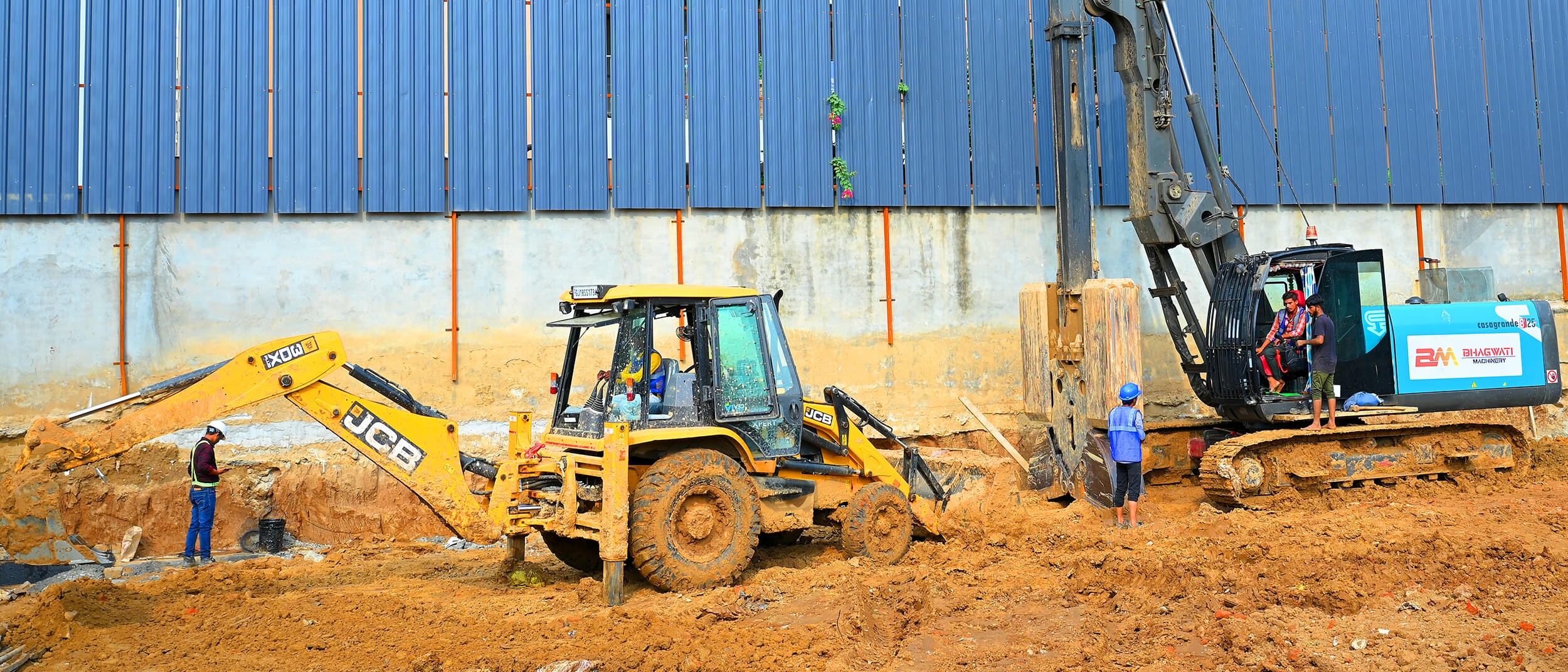
Blog | 19 September 2026
Diaphragm Wall Construction in India: Latest Trends and Future Growth
India’s rapid urban development is creating a growing need for advanced underground construction methods. Crowding conditions are increasing in cities, the availability of land is decreasing, and numerous new projects are demanding the construction of deep basements, underground parking, metro stations, tunnels, and other subterranean structures.
In such situations, the need for a safe and reliable excavation approach has grown in significance. Diaphragm wall construction in India has become an important solution for projects where deep excavation needs to be carried out close to existing buildings, roads, utilities, and other structures.
A diaphragm wall is a segmental, reinforced concrete underground wall. It is useful for controlling groundwater in excavation and is effective in retaining the surrounding soil. This method is still evolving due to the development of construction equipment, digital technology, monitoring systems, and project planning.
What Is Diaphragm Wall Construction?
Diaphragm wall construction is an advanced excavation and retaining wall installation method to form rigid underground walls. Usually, the steps include excavation of small panels in slurry, installation of reinforcement cages, and concrete pouring to create a continuous concrete wall with reinforcement.
Depending on the project requirements, the wall can be implemented temporary retaining or as part of the permanent structure.
This construction method is commonly considered for:
- Previous experience with diaphragm walls
- Availability of suitable construction machinery
- Technical expertise
- Experience with similar soil conditions
- Quality-control procedures
- Safety management
- Skilled site personnel
- Project planning capabilities
- Experience with deep excavation
- Ability to manage restricted urban sites
The technique is particularly suitable when open excavation is impractical due to the small space around the construction site.
What are the reasons for the increasing scope of use of Diaphragm Wall Construction in India?
Urban development in the major cities of India is ongoing for residential, commercial, transportation, and infrastructure projects. With the increasing costs of land, the need for more underground space is being increasingly considered for providing parking, services, storage and other facilities.
However, deep excavation can present problems with ground movement, groundwater, neighbouring structures, and underground utilities. A properly planned diaphragm wall can help create a controlled excavation boundary.
Another factor of note is the growth in metro networks. If a metro station and underground transportation system need to be constructed in a bustling urban area, it will need deep excavation. Large buildings and infrastructure developments may have similar requirements.
The demand is increasing and this is helping to create opportunities for specialized construction service, who have experience in underground excavation and foundation work.
Latest Trends in Diaphragm Wall Construction
New technology is transforming the planning and execution of underground construction projects. The focus of the latest developments is accuracy, productivity, safety, quality, and environmental performance.
Advanced Construction Equipment
With the use of modern equipment, complex excavation activities have become more efficient. Many large projects require the use of hydraulic grabs, cranes, desanding equipment, slurry treatment systems, concrete equipment, and monitoring instruments.
The correct equipment can make excavation more accurate and ensure the proper panel dimensions and depth.
The conditions for soil, wall depth, and ground water level, working space and project specifications are not always the same in various locations, which makes the selection of equipment a critical factor in a diaphragm wall construction service.
Digital Planning and BIM
The use of digital technology in the construction sector is growing in significance. Building Information Modelling, or BIM, can be used to coordinate project data, including structural information, construction sequences, reinforcement details, excavation requirements, and other project information.
Digital models can also help communicate between engineers, consultants, contractors and project owners.
In the case of large-scale underground construction, digital coordination can be useful in forecasting conflicts before starting works.
Better Quality Monitoring
The details of quality and safety monitoring are getting more complex in modern construction projects.
Monitoring for diaphragm wall work can include the following:
- Excavation depth
- Wall verticality
- Slurry properties
- Trench cleanliness
- Reinforcement placement
- Concrete volume
- Concrete quality
- Ground movement
- Groundwater conditions
By monitoring regularly, construction teams can find problems early on. This is especially helpful in deep excavation projects where fixing a problem after finished can be challenging and costly.
Focus on Safety
Careful planning is important for deep excavation projects because of the high excavation depths and heavy machinery involved.
New projects are increasingly focusing on access, training of workers, checks of equipment, site excavation monitoring, lifting work, emergency protocols and inter-team communication.
Safety should not be a distinct activity but should be considered at every stage by an experienced diaphragm wall construction contractor in India.
Sustainable Construction Practices
Environmental issues are playing an increasingly important role in the building process.
Sustainability can be achieved through efficient use of concrete and steel, responsible use of slurries, minimizing construction waste, efficient operation of construction equipment and handling materials responsibly in diaphragm wall projects.
For urban areas, noise and vibration may also be significant. Planning and use of the right equipment can minimize disturbance of adjacent property and public space.
Growing Use of Basement Diaphragm Walls
In large urban developments, the use of deep basements is becoming more prevalent. They can provide valuable space for parking, storage, building services, commercial facilities, and other uses.
A basement diaphragm wall can be used to provide the boundaries of a deep excavation and assist in holding back the soil surrounding the basement during excavation construction.
In urban environments, where structures and infrastructure are often situated near excavation boundaries, the need for basement diaphragm wall in India is especially pertinent.
One of the great benefits is that the wall is sometimes a permanent part of the structure. This can be an advantage in reducing the requirement of separate retaining systems if the project design and site conditions are conducive to using this method.
Future Growth of Diaphragm Wall Construction in India
Urbanization and infrastructure development are closely linked to long-term growth of underground construction in India.
Specialized excavation techniques may be required in metro systems, underground transportation facilities, large commercial buildings, high rises, industrial developments and deep basement construction projects.
Automation, digital monitoring, BIM, advanced materials, better machinery and sustainable construction methods are also expected to be used more in the industry.
Integration with Other Underground Construction Methods
Rapid urbanization in India is rapidly creating a demand for advanced underground construction methods.
Diaphragm walls are often used with other foundation and excavation methods. The work can involve piling, anchoring, dewatering, waterproofing, strutting, excavation, depending on the project.
Correct method will depend on soil conditions, ground water, and depth of excavation, building loads and nearby structures. Coordinating with various teams is crucial for easy project execution.
In some cases, a piling contractors team may need to work in collaboration with the diaphragm wall and excavation teams. A piling company in India can handle deep foundation work for residential, commercial, industrial, and infrastructure projects, while a piling service provider may use different piling methods based on site conditions.
Ground anchor systems can be used to complement retaining structures in certain projects.
Importance of Choosing the Right Contractor
Choosing the right construction team is an essential aspect of a diaphragm wall project.
When evaluating a diaphragm wall construction company, project owners should look at practical factors rather than considering only the quoted price.
Important points include:
- Previous experience with diaphragm walls
- Availability of suitable construction machinery
- Technical expertise
- Experience with similar soil conditions
- Quality-control procedures
- Safety management
- Skilled site personnel
- Project planning capabilities
- Experience with deep excavation
- Ability to manage restricted urban sites
Challenges That Could Affect Future Growth
Skilled Workforce
Diaphragm wall projects are complex and need highly qualified engineers, operators, technicians and site workers. With more complex projects, skillful teams will continue to be essential.
Difficult Ground Conditions
The depth and variation of soils may be very different from one location to another. Excavation may be affected by rock, groundwater, underground obstructions, loose soil and other unforeseen elements.
Cost Management
Construction costs may be influenced by the type of equipment, concrete, reinforcement steel, fuel, transportation, labor, and other materials and components involved in the project. With effective resource planning and good scheduling, you can minimise unnecessary costs.
Restricted Urban Sites
In urban areas, limited working space, traffic constraints, utilities, existing buildings, and noise constraints may be factors in construction. Careful planning of equipment movement, material storage, excavation sequences, and site access are necessary for contractors.
Why Choose Bhagwati Machinery?
Bhagwati Machinery specializes in foundation & underground works. The company combines technical expertise, suitable machinery, experienced workers, and project-focused execution for complex construction environments.
Working with clients who are seeking a diaphragm wall construction service provider, it is essential to consider how they evaluate technical expertise, equipment availability, quality procedures, and previous projects before beginning work.
Different soil, groundwater, structural and space conditions at each construction site. Hence, the construction method must be designed based on the specific needs of the project.
Conclusion
The rapid urbanization in India is increasing the demand for effective utilization of the underground space. In the construction industry, requiring an effective excavation and retaining solution is essential for deep basement projects, metro stations, tunnels, and commercial buildings.
High-tech equipment, digitization of planning and supervision, the new safety systems and eco-friendly construction methods are transforming the way such projects are conducted.
For a diaphragm wall construction India project, the right combination of engineering knowledge, equipment, planning, quality control, and experienced professionals can help achieve reliable construction results.
FAQs about Diaphragm Wall Construction in India
What Is a Diaphragm Wall Used For?
The main function of a diaphragm wall is to retain soil and help manage groundwater during deep excavation. It is commonly used for building basements, metro stations, tunnels, and other underground structures.
What Are the Uses of Diaphragm Walls in Deep Basements?
Diaphragm walls provide a strong excavation boundary and can be constructed near existing structures where traditional open excavation methods may not be practical.
What Factors Affect Diaphragm Wall Construction?
Soil conditions, groundwater levels, excavation depth, wall thickness, panel dimensions, reinforcement, concrete specifications, surrounding structures, equipment, and site restrictions are some of the important factors.
Can a Diaphragm Wall Be Built in an Urban Project?
Yes. Diaphragm walls can be suitable for urban areas with limited space, especially when deep excavation is required near roads, buildings, and other existing structures.