



Blog | 16 September 2026
Diaphragm Wall Construction: Types, Cost & Applications
Deep excavation is one of the major components of modern construction projects. Strong retaining systems are required to maintain stability of the soil around a building as they get taller and underground spaces are becoming more common. In deep excavation, basements, metro stations, tunnels, and other underground structures, one of the solutions used are the diaphragm walls.
There are multiple factors to consider when deciding on a wall. Important factors include soil condition, depth of excavation, groundwater level, wall thickness, size of the project, site access and construction requirements. The other important factor to consider is cost of the work as a special type of equipment, concrete, reinforcement steel, slurry, skilled labor and good site management is required.
Diaphragm Wall Construction: What is it?
Diaphragm wall construction is a method used to create a deep underground retaining wall. Typically, the wall is constructed in parts known as wall panels. The panels are dug to a specific depth and then concreted, sometimes reinforced as necessary by the structure.
A stabilizing slurry is usually used to help stabilize trench sides during excavation. When the trench goes to the desired depth, the reinforcement cage is installed in the trench. Concrete is then poured in to create the wall panel.
When all the individual panels are assembled, they form a solid bottom wall. This wall can help in soil retention, minimizing ground movement, and support from deep excavations.
This method is especially beneficial when the construction site is small or when the project is being built near structures, roads, and buildings.
Why Are Diaphragm Walls Used?
There are many uses of diaphragm walls in construction. Their application depends on the project design and ground conditions.
Some of the common advantages involved are:
- Providing support during deep excavation
- Reducing movement of surrounding soil
- Helping manage groundwater around excavation areas
- Creating strong underground retaining structures
- Supporting basement construction
- Working in areas with limited space
- Helping protect nearby buildings and infrastructure
- Providing long-term structural support when designed as a permanent wall
Proper geotechnical investigation and structural calculations need to be used to determine the exact design of the wall. What works for one site probably will not work at another site.
Main Types of Diaphragm Wall Construction
Based on the purpose of the project and required structural performance, different types of diaphragm walls can be used.
Reinforced Concrete Diaphragm Wall
Deep excavations are often made of reinforced concrete walls. Steel reinforcement cages are placed inside the excavated trench prior to the pouring of concrete.
The reinforcement prevents the wall from bending or other forces and the concrete gives strength and durability.
These walls can be used for:
- Deep basement projects
- Metro stations
- Underground parking areas
- Tunnel construction
- Large commercial buildings
- Major infrastructure projects
The thickness and depth of walls are determined by the project conditions, such as structural calculation, soil pressure, groundwater, depth of excavation, etc.
Unreinforced Diaphragm Wall
An unreinforced diaphragm wall can be used for situations where the wall is not needed to support heavy structural loads. This type is suitable for projects depending on soil type, depth of excavation, groundwater conditions, and project requirements. It is not suitable for all deep excavations.
Engineers must determine the loads and the possibility of ground movement before choosing an unreinforced system. Only after reviewing the construction site and requirements, the construction method can be chosen.
Temporary Diaphragm Wall
A temporary diaphragm wall is constructed to provide support during a specific stage of a project. It can be used during the excavation process or before finalizing the permanent underground structure. Temporary walls can be beneficial when extra stability is needed during the process of excavation.
The design typically is based on the duration for the expected construction, the order of excavation, loads from nearby structures, ground water and site conditions.
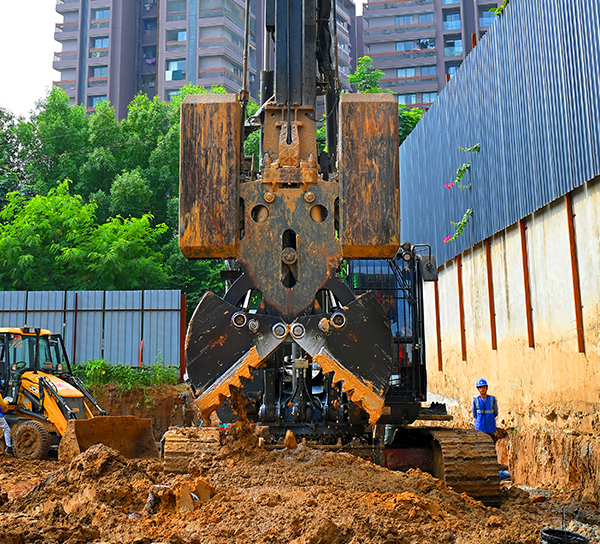
Hydromill Diaphragm Wall
A Hydromill diaphragm wall is made with the panel excavation by the Hydromill cutter. The cutter uses rotating wheels to break and remove soil and can be useful in hard ground conditions. Hydromill equipment may be suitable for hard soil or projects with difficult ground conditions.
What is the cost of a diaphragm wall construction?
There is no standard price for a diaphragm wall. This depends on the size and complexity of the project and the site conditions.
This cost can be determined by the contractors based on the size of the wall involved, material, depth of excavation, equipment, labour, and other factors related to the project.
Major cost components are explained below.
Excavation Cost
Excavation is a primary activity in the construction of walls. The price varies based on the depth of the trench, type of soil, and size of the panels, machinery used and excavation speed. For hard layers, boulders, or rock in the ground, excavation may be longer and necessitate more equipment or techniques.
Concrete Cost
The basic structure of a conventional diaphragm wall is a concrete structure. The required quantity depends on the wall length, depth, and thickness. In addition, the overall cost of the material could be influenced by the chosen concrete grade and project requirement. The more concrete needed in a larger wall section means higher costs.
Reinforcement Steel Cost
The other major cost factor for reinforced walls is steel reinforcement. The required quantity is determined by structural calculations. If a wall is to be strengthened for higher loading, more reinforcement is needed. Reinforcement also has an impact on the requirements for fabricating, transporting, lifting and installation.
Slurry Cost
Slurry is used to stabilize trenches. It helps to stabilize the excavated trench until reinforcement and concrete are placed. Slurry material, preparation, testing, circulation, treatment, recovery and disposal may all be included.
Machinery and Equipment Cost
Specialized construction equipment is needed for diaphragm wall work. This can range from excavation grabs, cranes, slurry treatment equipment, desanding systems, reinforcement handling equipment, and concrete placement systems. The total cost of equipment can vary based on rental, transportation, equipment operation, maintenance, and utilization time.
Labour Cost
Qualified operators, engineers, supervisors, technologists, and construction workers are needed for this work. Labour cost is dependent on project location, duration, working hours, complexity and labor requirement. A synchronized technical team and a site team can help to keep construction running smoothly.
Groundwater Management
Deep excavation may be more challenging if the groundwater is present. Depending on the groundwater level, further planning and control measures may be necessary. These measures can lead to a higher requirement for equipment, more construction hours and higher construction costs.
Factors That Affect Diaphragm Wall Cost
There are a few technical and site factors to take into consideration for estimating the full cost.
Wall Depth
The greater depth of the wall means more excavation, concrete, rebar, and equipment time, as well as more slurry management. Therefore, wall thickness can make a great difference in project costs.
Wall Thickness
Thicker wall means more concrete and reinforcement. The required thickness is normally determined by structural and geotechnical calculations.
Total Wall Area
Wall area is the total length x depth of the wall. A larger wall area means greater material and construction requirements.
Soil Condition
Excavation speed and equipment selection may be influenced by soil conditions. The work can be more difficult in dense soil/boulders/rock or gravel. A site investigation will help engineers to understand ground conditions before works start.
Project Location
The cost of materials, transport, available labour, the need to move equipment and site conditions will differ from location to location. This is one of the reasons behind the construction rate differences across different cities.
Construction Schedule
Sometimes, the cost can also be influenced by the completion time of such work. Some projects can involve extra shifts, equipment, or labor due to the time constraints. Scheduling can minimise unnecessary delay and maximize the use of equipment.
Basement Diaphragm Wall in India
In many cities in India, the use of underground construction has grown as space is become limited, and buildings often need basement parking and service areas.
Basement diaphragm wall in India is recommended for commercial buildings, residential projects, metro projects, and other buildings with deep excavation requirements.
Diaphragm Wall Construction Service for Different Projects
In most cases, a professional diaphragm wall construction service can be designed based on a project’s requirements.
The work may be required for:
- Residential buildings
- Commercial buildings
- Industrial structures
- Underground parking
- Metro stations
- Tunnels
- Infrastructure projects
- Deep excavation sites
How to Choose a Diaphragm Wall Construction Company
When choosing a diaphragm wall construction company, take into consideration the following:
- Experience with similar projects
- Availability of suitable machinery
- Skilled technical and operating teams
- Knowledge of deep excavation methods
- Quality control procedures
- Safety practices
- Ability to follow project schedules
- Proper reinforcement and concrete planning
- Understanding of local ground conditions
- Clear project communication
Role of Experienced Foundation Contractors
For deep foundation works, it is essential to have a proper planning and coordination. Piling contractors may be involved in projects where deep foundation and excavation activities are required together.
When foundation piling is part of the development, the selection of a piling company in India should also depend on its experience, equipment, technical expertise, safety practices, and past projects.
Depending on the design and the ground conditions, further support might be required for deep excavation works. In some cases, ground anchor systems can be considered as part of the overall excavation support arrangement.
An experienced diaphragm wall construction contractor in India can plan these activities according to the project’s technical requirements and site conditions.
Why Choose Bhagwati Machinery?
Bhagwati Machinery specializes in construction needs for deep excavations and foundations. The team is equipped with experienced engineers and skilled technical professionals who plan activities based on the needs of each project.
Using modern equipment can help optimize excavation accuracy and construction efficiency. Other factors that are crucial for the construction of a diaphragm wall include the proper planning, quality monitoring, safety measures, and timely completion.
Construction method may be changed based on site conditions, project scale, excavation depth, soil conditions and other technical requirements.
Conclusion
Diaphragm walls are useful in numerous deep excavation or underground construction projects. Depending on project purpose, soil conditions, groundwater level and construction method, different wall types can be chosen depending on the desired structural performance.
The pricing is based on the project requirement. The price varies between different sites due to varying excavation depths, wall thickness, materials, equipment, labour, soil and groundwater, and accessibility.
The construction of a diaphragm wall can be made controlled and efficient, if the right equipment is chosen, the quality of the work is ensured and the technical staff is experienced.
FAQs about Diaphragm Wall Construction Types and Its Costs
What Are the Main Types of Diaphragm Walls?
There are various types of diaphragm walls, including reinforced concrete walls, unreinforced walls, temporary walls, and Hydromill diaphragm walls. The suitable type depends on the structural requirements and site conditions of the project.
How Do I Select a Diaphragm Wall Contractor?
When selecting a diaphragm wall contractor, consider their previous project experience, equipment, technical team, quality control practices, safety procedures, project planning, and experience with similar soil conditions.
What Factors Affect Diaphragm Wall Construction Costs?
Important factors include wall depth, wall thickness, wall length, soil conditions, groundwater levels, reinforcement, concrete quantity, slurry requirements, machinery, labour, site access, and construction time.
Can Diaphragm Walls Be Used for Metro Projects?
Yes. Diaphragm walls can be used for metro stations, underground structures, tunnels, and other infrastructure projects where deep excavation and retaining support are required.